Showing posts with label Plant collections. Show all posts

Thursday, April 22, 2010

What A Difference Six Months Makes

Earlier this month, around the tenth of April, I put the remains of my Hedera helix collection out on the porch. This was well in advance of my local average last frost date (May 15.) However, since the original Hedera helix species is hardy in the ground around here, I figured that my potted cultivars could handle the light frosts we get this time of year. They are on a covered porch, and if a hard freeze was forecast, I could always bring them inside for the night.

Here is what I brought inside last October:

Seventeen happy Hedera helix cultivars

Here is what I put out this month:

Eight somewhat bedraggled Hedera helix plants, four of which I didn't even have last fall. Sigh. The Pelargonium seems much unchanged since last fall, having spent the winter blooming intermittently in my bedroom window.

I lost several plants to spider mites this winter, including some of my favorites. My success the previous winter made me overly optimistic, I guess. Those mites are the devil incarnate. In fact, they are the reason I put the plants out so early. I figured the mites would find the fresh, chilly air discouraging. (I also washed the plants with a soap/water/alcohol solution before putting them out.) Despite the setbacks, I am determined to replenish my collection.

Monday, March 1, 2010

New Month, New Plants--March 2010

Okay, technically, it is "Old month, New plants," since I bought these yesterday. But hey, I'm posting today, and it's March, one month closer to spring, so humor me. (I mean real spring, which will begin here, in the far reaches of Chicagoland, sometime around mid-April, not that faux spring they tease us with on the Equinox.)

Anyway, here they are:

Hoya publicalyx

I believe that in one of my previous posts, I mentioned that I wasn't looking for more Hoyas. As is apparent, that didn't mean I was going to reject anything interesting that came my way. I'm just not starting a collection of them. No sir, not me. That's my story and I'm sticking to it.

Cryptanthus spp.

On the other hand, I do fully admit to having been bitten by the Bromeliad bug. I passed up a largish Neoregelia 'Fireball,' but I decided to buy this Cryptanthus instead. There may be more of these in my future, as I've always liked them.

Tuesday, December 8, 2009

Nice and Easy

Even though I am an inveterate plant collector by temperament, there was one particular collecting bandwagon that I resisted jumping on: Hoyas.

I remember when Garden Web first created a Hoya Forum. It was immediately extremely popular, and remains so, unlike a lot of their forums dedicated to a single genus or family. The people who posted were enthusiastic, no, passionate about these plants. More than one person described waiting impatiently for new plant shipments to their local big box stores, and expressing huge disappointment if there were no Hoyas. New mail-order sources were shared, and as I understand it, they sold out of plants quickly. On the House Plant forum, when anyone would ask for suggestions about what sort of new plant they should buy, Hoyas were always suggested, usually by multiple posters. Hoya, Hoya, Hoya, it was all about the Hoyas.

My six Hoyas. This a rare thing for me--a completed collection. I like the plants I have, but I'm not looking to add any more. Click this, and all other photos, for larger versions. This shot in particular is much clearer when seen full sized.

Okay, I thought, they are nice enough plants, but why is everyone so excited? One thing that was mentioned frequently was the scent of the flowers. So the next time I was at a nursery and came upon a plant in bloom, I sniffed it. Well, the fragrance was nice, but not all that noteworthy, at least not to me. The leaves, again, are nice, but with the exception of Hoya carnosa compacta, (also known as Hindu Rope or Krinkle Kurl, among other variety names) not at all unusual or eye-catching.

I just didn't get it. But having had an inexplicable plant passion or two of my own, I stopped wondering about it. Just like other things in life, certain plants just move certain people, and Hoyas didn't do it for me.

But just as I couldn't work up a passion for Hoyas, I didn't have anything against them, either. I've used the word "nice" a lot in this post, and I like nice plants. So one day, four years ago, when I shopping at one of my favorite nurseries, I picked one up. It was a variegated H. carnosa variety in a two-inch pot. Here it is today in a 10-inch pot:

Hoya carnosa 'Krimson Queen'

It's been nice. I have found it attractive and easy to grow. It loves my east window and does well going almost dry between waterings. Now that it is large, it does bloom, and the flowers are interesting, and they have a nice, subtle fragrance.

So, over the course of the four years, six Hoya plants came into my life. (There was a seventh plant, a small H. multiflora, which died. The leaves were less succulent than those of my other Hoyas, and apparently, it needed more water than it was getting.)

Hoya carnosa 'Rubra'

Hoya curtisii leaves. The full plant is shown directly in front of the 'Krimson Queen' in the group photo.

Hoya kerrii has nice, heart-shaped leaves.

Another variegated Hoya carnosa.


So there you have it. I never sought them out, I was never excited about them. But if I saw a plant I liked, I bought it. What can I say: they're nice.

Wednesday, November 18, 2009

More Aloes

As a follow-up to my last post, I thought I'd share a few more pictures of my Aloes. One thing I noticed, and am mildly embarrassed about, is that I don't have positive IDs for quite a few of my plants, beyond being sure that they are Aloes. This works out okay in caring for them, but seems, well, somewhat lacking if I am going to write about them.

Aloe variegata

Possibly Aloe 'Dapple Green'


Aloe brevifolia

Maybe Aloe bellatula, maybe not

Aloe striata. This isn't a plant with offsets, but rather three individuals potted together.

Small Aloe juvenna, grown from offsets of my larger plant (not pictured)

NoId Aloe, with very sharp teeth

This one looks like it could be Aloe 'Doran Black' but I am uncertain.


Aloe greenii x linneata. I had another of these, and it was a bit different looking, with larger spots. That one developed unsightly black depressions on the leaves, so I tossed it.

I think this is Aloe saponaria. I think that because I know I bought an A. saponaria a few years ago, and I know that I didn't get rid of it. Since I don't have anything else that could possibly be A. saponaria, by process of elimination, this must be it. I post this as a cautionary tale: Don't lose those tags boys and girls!

Monday, November 16, 2009

How I Ended Up With Thirty Aloes

In my very first blog post last month, one of the questions I posed was "Thirty Aloes? How the hell did that happen?" So I thought it was high time I answered it.

For years, Aloe was one of those plants that I was distinctly unexcited about. That is because I basically thought Aloe was one of those plants. You know, Aloe vera: dull green, maybe with a few random spots, pointy and bland. (Or at least that is what is typically sold as Aloe vera; I understand there is a case of mistaken identity going on.) I guess I knew in the back of my mind that there were other species around, but I thought they were more of the same. Dull green, pointy and boring. Hah.

Twenty-one Aloes enjoying last summer in my backyard.

Maybe about five years ago, someone on Garden Web posted a picture of an Aloe with deep green, shiny leaves and a pattern of not quite stripes, not quite spots. I thought it was quite lovely, not boring at all. "That’s an Aloe? Hmm. Maybe there is more to this genus than I thought."

A similar species to the one that caught my eye on Garden Web. This might be Aloe harlana, or Aloe hemmingii, or a hybrid, or something else entirely.

For some reason that very summer, the box and discount stores in my area were full of interesting aloes. I must have picked up six different varieties at Home Depot alone. This was a true case of wanting the right thing at the right time: I’ve never seen that broad a selection of aloes around here since. It isn’t that I bought everything that they carry and am thus jaded with what is available. It is that they don’t even carry the ones I do have anymore. That same year I also purchased several plants from a couple of local nurseries and on eBay.
Aloe congolensis

That year the collector’s fever was truly upon me, similar to what I’ve recounted in my posts about Hedera helix. Once I found out how many varieties there were to be had, I had to have as many as possible. Everywhere I went that sold plants, I looked for a new Aloe. Since then my ardor has cooled; I still like them, and still keep an eye out–but the thrill of the hunt is gone.

My experience with Aloes has been very rewarding; I find them to be excellent succulents for those of us who must keep our plants indoors for the winter. They slow down their growth in response to lower light, but they do not take on a leggy appearance, like say, Echeveria (my other favorite succulent genus.) Even if they do stretch out a bit, it is generally not enough to disfigure the plant.

Aloe marlothii. This one is actually more ferocious than Aloe ferox, with which it is sometimes confused. This was actually my first Aloe purchase, almost 6 years ago. Even though I likely knew that it was an aloe, I really didn't think of it as one. (I didn't get an actual ID until later.) It was in a two-inch pot when I bought it; now it is almost large enough to sit at the dinner table.

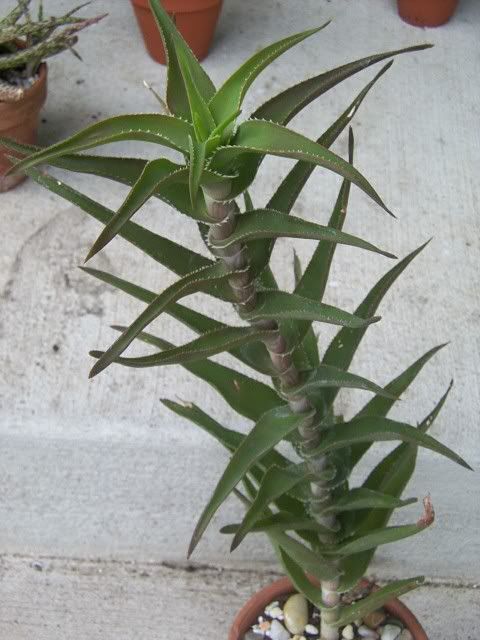
Probably my favorite Aloe. I've never been able to get a positive ID, though Aloe sinkatana has been brought up as a possibility.

Another NoId favorite, with its summer colors. It reverts to green after some time indoors.

Possibly Aloe gariepensis

Aloe ciliaris

Aloe dichotoma. I over watered this one a few winters ago, and the roots and lower stem rotted. I took a stem cutting above the damage, and kept my fingers crossed. It took almost two years, but it finally rooted. Edited to add 07/31/10: It has been brought to my attention that this is mostly likely Aloe ramosissima, rather than A. dichotoma.

Finally, this isn't one of my plants, of course. It is a tree-sized Aloe in the collection of the New York Botanical Gardens. I wish I had written down its name. This photograph is from 2003 and is one of my favorites I've ever taken, even though it was done with a rather low-tech camera. As with all the photos it can be clicked for a larger version.
11/18/09 Edited to Add: This is probably Aloe barberae, which is also known as Aloe bainesii.

Friday, November 6, 2009

Adding to the Hedera Collection

Yes, I found two new Hedera helix cultivars to add to the collection. They were hiding among a tray full of otherwise typical-looking ivies at Home Depot. I've already dressed them up in their red pots, though those aren't really visible in these pictures.

I'm pretty sure that this is Hedera helix 'Teardrop'

Close up showing the shape of the leaves

Oddly fused leaf

Very pretty NoId cultivar with white variegation

This includes an all-white branch. Though removing such branches is usually recommended in order to improve a plant's vigor, I'm going to leave it for now. (Maybe forever. It is so pretty.)

It also has unusually-shaped leaves. Check out the double point on the bottom lobe of the leaf I'm holding. Many, but not all of the leaves have that shape.

Please click on the pictures for larger versions. It'll be worth your while. I promise.

Wednesday, October 28, 2009

The Ivy Chronicles, Part II

So about a week after I ended up with three additional ivy plants, I was shopping at another store, checking out the annuals. Not only can a girl always use a few more petunias for her outdoor baskets, but lots of plants that other folks consider annuals are actually tender perennials that make fine houseplants. (This year, I scored another Asparagus “fern”, a Crossandra , and a Pilea cardieria, and decided against a Dragon Wing Begonia. But again, I digress.)

And while shopping, what do I spy among the annuals? More ivy! And these are different from the ones I already have. There is a variegated type whose leaves remind me of yellow-edged flames, (possibly Hedera helix 'Yellow Ripple') and a beautifully patterned green and white variety, which I have tentatively identified as Hedera helix ‘Kolibri’ Of course I buy them. At this point, I’m not even pretending that they are for my wreath. These will be houseplants.

I think this is Hedera helix 'Kolibri'

So I was up to six plants. And I’ve made a little pact with my husband: Starting on June 1st of 2008, I’m not going to buy any more houseplants for six months. My husband is a great supporter of my houseplant hobby. However, he was a bit worried about me back then. I had been suffering from plant care burnout. And our budget needed a break. So I stop visiting the houseplant sections of nurseries, and my ivy acquisitions ceased.

Summer comes and goes, and I bring my ivies indoors, to live in my bedroom window shelves. This window is ideal for ivy in the winter. It gets quite cool at night, because I break a cardinal houseplant rule: I let the plants stay between a window and the closed curtain during the night. I’ve never had a plant object to this treatment, though I might remove a few tender plants temporarily when the Chicagoland night temperatures hit the single digits, Fahrenheit.

The six months of our pact pass relatively quickly. The ivies have all done well under the mist-and-wash regimen described in Part I. And since I think they look so lovely in the red pots, I decide that if I do buy more ivies in the future, that is what I will use for them all.

In late January, Bob and I are in Lowes shopping for who-remembers-what, and I wander into the houseplant area. And what do I see? Another Hedera helix that I don’t have. This one has small, lobe-less leaves, with a hint of chartreuse coloration.

NoId as described in the paragraph above

And so it continues. A trip to my favorite nursery yields a Heart-shaped Hedera. I don’t know if this is actually Hedera hibernica ‘Deltoidea’ or one of the heart-shaped H. helix varieties, but I had to have it. Then I’m at the supermarket, and I decide that if I’m going to have an ivy collection, I need a plain green variety in the classic ivy shape, so another plant finds its way into my cart.

Hedera hibernica ‘Deltoidea’ ?


And then there were nine. A midwinter trip to Home Depot finds me scooping up an ivy with curled leaves and stems, and another with small, nearly lobe-less leaves and white variegation (maybe H. helix ‘Little Diamond’)

I’m up to eleven now. Another nursery trip nets me a Hedera with gray-and-lime green variegation.

NoId Hedera helix with gray and lime variegation
Edited to add: This may be H. helix 'Minty'


And last but not least, a mail-order purchase, pictured below:

Hedera helix ‘Fluffy Ruffles’

There have been some setbacks. In early May, a crisis in my personal life, which involved a certain amount of travel, caused me to neglect my ivy regimen. This, combined with a warming trend in the bedroom window, causes an outbreak of mites. (Just as it gets cold between the window and the curtains on winter nights, it gets quite warm in the spring and summer.) I was heartbroken, as two of my favorites, the original plant that started it all, and the needlepoint, are the most affected.

I immediately move the ivies outside, where I spray them down with soap, then blast them with the hose. I also pick off the most damaged leaves. A couple of days later, I spray everyone with fish emulsion, in the hopes it will help the leaves that were only minimally damaged to green up a little. This actually seemed to work pretty well. I promise myself to never let the mites take hold again.

So, here I am in October 2009. I added a few more plants, so I now have 15, all in their red pots. (I did have two more, but they were tiny plants that didn’t survive the summer.) I’ve started the regimen again, and I’m hoping in the future, the transition from winter to spring will be easier. I’m not as obsessive a collector as I pretend to be; I do pass up plants, even Hederas, that don’t appeal to me, all the time. I don’t find every ivy beautiful (or every Aloe, or every Sansevieria–these are the other genera that I always look for.) But there are a lot more out there that I will find beautiful, and quite of few of them will be coming home with me.

This, and the plant below, are two Hedera NoIds I've added this year, but aren't mentioned in the text of this post.
Love those elongated leaves!
Edited to add: this is probably Hedera helix 'Hester'

Tuesday, October 27, 2009

The Ivy Chronicles, Part I

I've always loved Hedera helix. It's just one of those plants I find beautiful. But it was on my "never again" list for at least seven years. (Well, I suppose the list should really be the "Never-again-as-of-this-moment-but-I'll-probably-change-my-mind" list, but I digress.) Ivies always succumbed to something, usually spider mite troubles, exacerbated by the warm dry air of the apartments where I lived. In fact, even if they didn't have mites, the warmth, plus my tendency toward erratic watering, proved their downfall. I even tried to get that ivy look by trying Senecio macroglossus variegatum, which looks very much like Hedera helix. But that plant comes with its own set of quirks, and didn't work out for me, either.

Then, in the fall of 2007, I was offered some Hedera helix cuttings in a situation where it felt awkward to turn them down. Although I loved the shape and petite size of its leaves, the source plant was not especially attractive. It was a bit straggly and its leaves looked rather bleached out, which I attributed to mite damage. But I accepted the cuttings, and brought them home to root. I washed them thoroughly with soapy water, gave them a good cold-water rinse, and placed them in a nice blue glass vase to root in water. I had to admit that they looked kind of pretty. I never had luck rooting ivy cuttings back in the day, so I didn't really expect anything to come of my efforts. But at least I could say that I gave it a try.

I was wrong. The cuttings rooted eagerly. And once I potted them up and started to fertilize regularly, the leaves actually greened up nicely. The pale coloring hadn't been mite damage after all; my best guess is that the source plant was probably just underfed, under lit, and kept overly warm.

My original ivy, as of yesterday

I was psyched. I had a pretty plant. Now all I had to do was keep it alive and mite free. So I started my ivy regimen: Misting it with water every morning and giving it a soap-and-water washing and cool rinse every other week. Now, I do not believe in misting my houseplants for humidity; studies have shown that to be ineffective. However, it is my understanding that spider mites love things hot and dry, and are repelled by cool water. I do have a few air plants (Tillandsia species) that I mist daily as their source of water. So I kept my ivy in the same window, so as not to forget to give any incipient mites their daily discouraging blast of water. With this system, my plant thrived and made it through the winter, looking lovely and full.

View showing whole plant

So spring of 2008 arrives, and I have an idea. I always wanted to try a living wreath, and I always thought that different cultivars of Hedera helix would look gorgeous in such a display. I knew from observation in previous years that the big box stores sell ivies as ground covers and outdoor annuals quite cheaply. So off I go to Home Depot. I found a couple of different ivies with white variegation and yellow variegation with the outdoor plants, as I expected, so I get a few of those.

White variegated Hedera helix, possibly H. helix 'Glacier'

Then, indoors among the houseplants, I found some plain green varieties in a standard ivy shape, and a needlepoint shape. (I don't know if it is the actual cultivar called 'Needlepoint,' so I'll leave it uncapitalized.) They were the same price as the outdoor plants, so I buy a few pots of those. So I'm all set. These will be for my outdoor wreath only. Hah! I make my wreath and of course, I have ivy left over (both variegated types and the needlepoint.) I pot them in pretty red pots, and place them on my porch, where they join my original plant, which is enjoying a season outdoors. So now I have four plants. "That's not so bad," I tell myself, as I slip into denial.

Hedera helix with pointy leaves. The leaves are thinner than pictures I've seen of the cultivar called 'Needlepoint'

Tune in tomorrow for part II.